
External Venetian Blinds
Wide aluminium slats mounted outside the glass, not inside it — the difference between managing heat that's already indoors and stopping most of it before it ever gets there. The reference case for Fresnaye and Camps Bay's glass-box architecture.
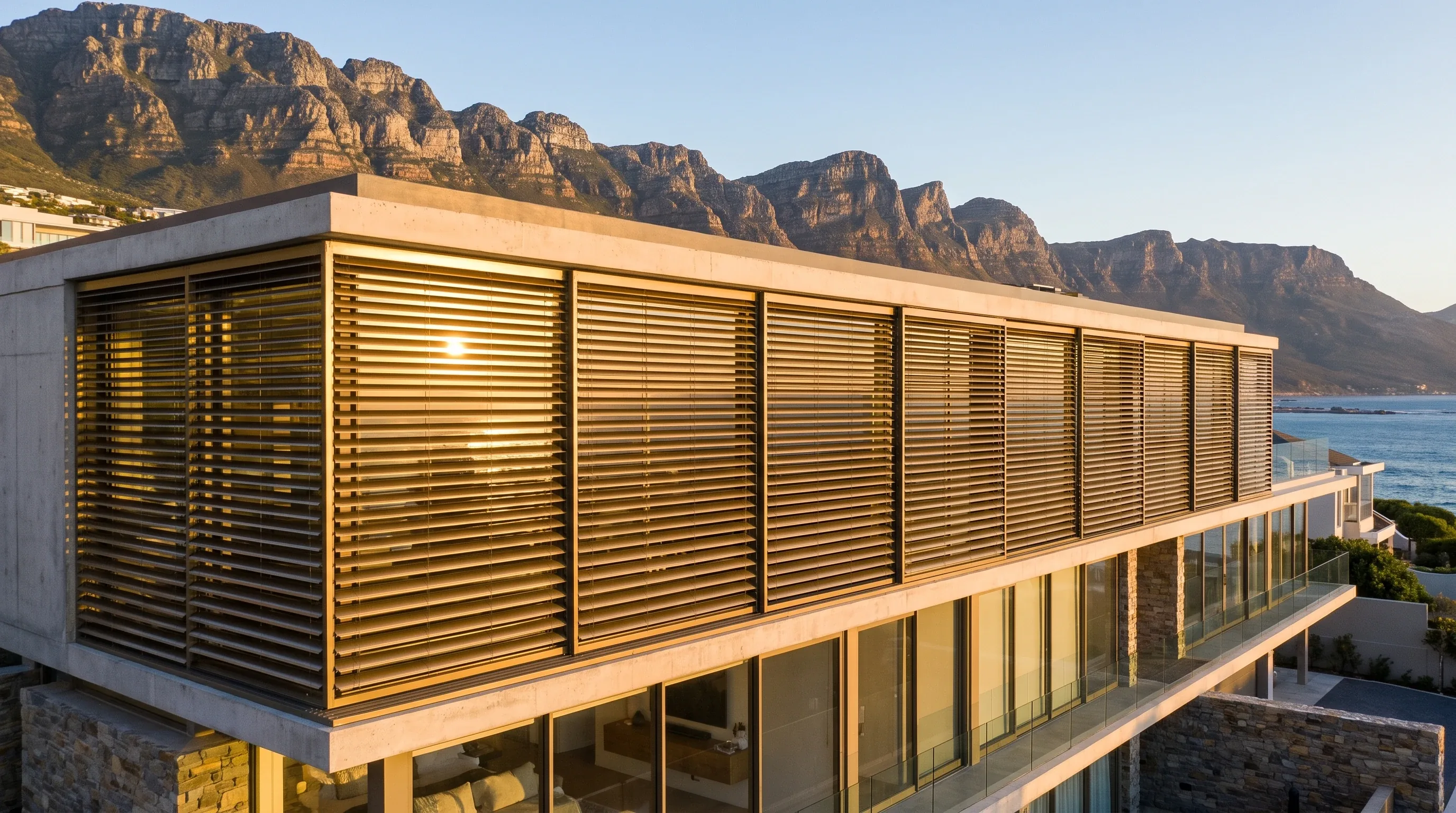
Why exterior beats interior on a west wall
An interior blind — roller, venetian, cellular — manages heat that has already crossed the glass and is radiating into the room. An external venetian intercepts most of that heat before it reaches the pane at all, because the slats are doing their work in the open air, not against warm glass. On the Seaboard's north- and west-facing glass boxes, that's the difference an aircon can actually keep up with.
It's how European and high-end South African architects have shaded glass buildings for decades, and it's why Fresnaye-class properties — frameless glazing, hard west exposure — are the reference case: the owner has usually already found that the aircon isn't winning on its own.
02Built for the Cape Doctor, not a still afternoon
A facade-mounted blind lives outside, permanently, which means the wind rating isn't optional. Every external venetian we fit here is effectively motorised, with a wind sensor that raises the slats automatically before a gust arrives — essential under the Twelve Apostles wall, where Camps Bay and Clifton in particular see the south-easter accelerate hardest.
Manual external venetians exist, but on an exposed elevation we don't recommend relying on someone being home to react to a wind change.
03Salt air and the honest maintenance line
Slats run in the 60–90mm class in powder-coated aluminium, engineered for weather exposure and guided in side rails or cables so they hold their line in wind. Powder coating handles the Atlantic's salt-laden air far better than an untreated finish, but we're upfront that even marine-spec hardware appreciates an occasional fresh-water rinse — the honest answer, not the sales answer.
- Wide aluminium slats (60–90mm class), tilt and raise, powder-coated marine-grade finishes
- Effectively always motorised, with wind-sensor auto-retract as standard on exposed elevations
- Facade fixing points needed — retrofit is possible, but new-build or renovation planning gets the cleanest result
What external venetians cost here
External shading is engineered hardware hanging on the weather side of the glass, and it is priced accordingly. By the square metre installed, as a guide: a crank-operated external venetian runs R3,000 to R4,500, with wider slat sections and more exposed fixings sitting higher. Motorised, with the sensor and control gear, expect R4,500 to R6,500.
Two honest notes. Small openings attract a minimum, because the guides, the headbox and the crew time barely change with the size of the window. And a wired motor wants a power point at the head of the opening, which is an electrician's cost rather than one of ours. Nothing is fixed until the free measure has been done and the itemised quote issued.
One honest limit
This is a visible change to the facade, so on sectional-title buildings and some estates it needs body-corporate or committee sign-off before we fix anything. Premium spend, and not a DIY product — but on hard west glass, often the single most effective thing you can specify.
From Fresnaye's frameless glass to every other exposed elevation on the strip, external venetians are the facade specialist across the whole Atlantic Seaboard.
Get your Atlantic Seaboard glass measured
Free in-home measure, a full written quote, no obligation.
Book your free measure