
Where the Sun Goes All the Way Down
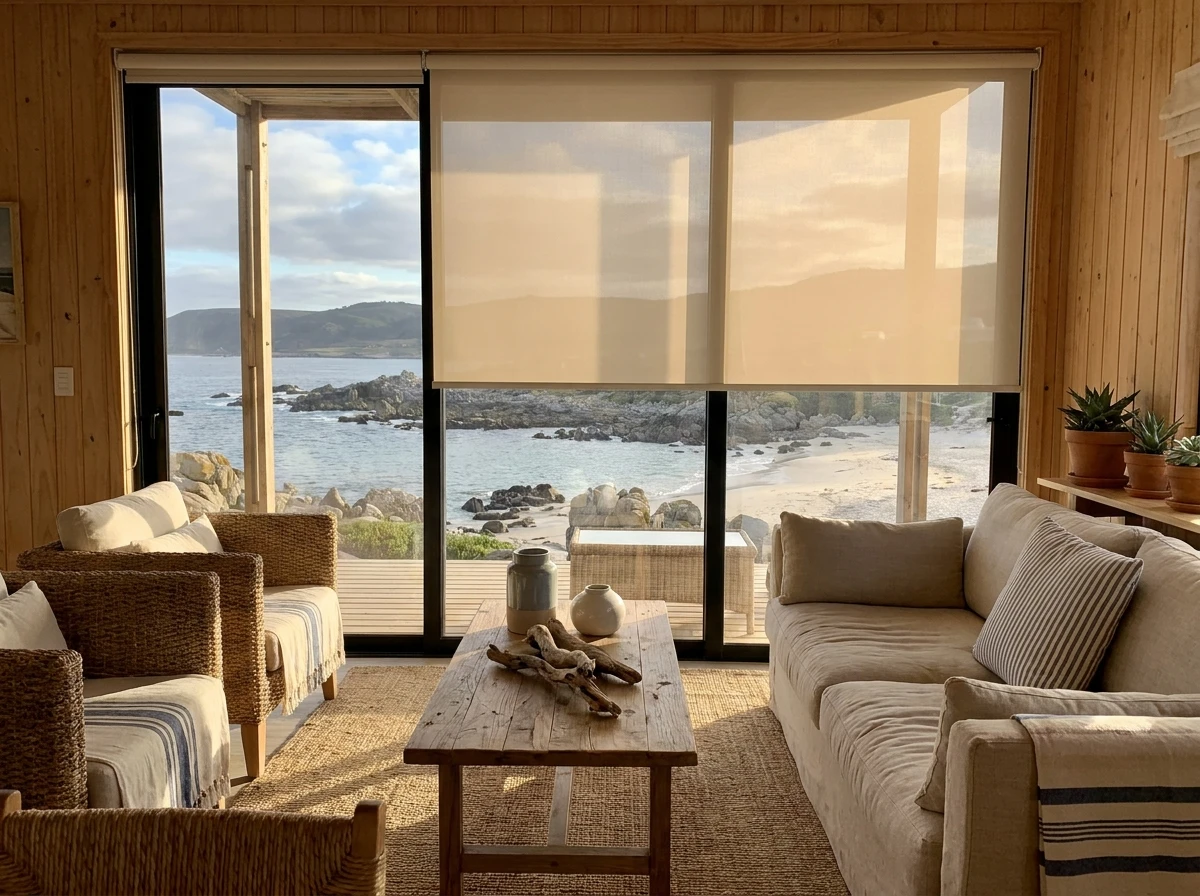
Almost everywhere else in Cape Town, the sun disappears behind something before it finishes. On this coast it falls the whole way to the water — and the last of it arrives at eye level, through the glass. Five questions you can answer about your own home before anyone quotes you a cent.
Short on time? Grab the PDF and come back to it — 11 pages.
An open western horizon changes the arithmetic
Cape Town sits at roughly −33.93° latitude, and the numbers that follow from that are the same for every home from Mouille Point to Llandudno. At the December solstice the sun stands about 80° above the horizon at solar noon and finally sets at an azimuth near 240° — well south of due west. At the June solstice noon is down to about 33°, due north, and sunset swings round to roughly 297°.1
What makes this strip different from the rest of the city is not those angles. It is what the sun does with the final ten degrees of them. In the City Bowl, in the southern suburbs, along most of False Bay, the sun clips a ridge or a mountain shoulder and the day ends early and softly. Out here the western horizon is open Atlantic all year round, so nothing intercepts the last of it. That closing stretch — light arriving almost horizontally, under every eave, overhang and balcony slab ever poured — is delivered in full on any clear evening. It is the single reason so much of what gets fitted on this coast belongs outside the glass rather than behind it.
The postcard hour and the problem hour are the same hour. That is the whole brief.
Two more region-wide facts worth carrying into the questions below. First, summer here is genuinely fierce: Cape Town's UV index averages around 12 in November and peaks near 14 in December, deep inside the “extreme” band that starts at 11.2 Fabric fades, timber floors bleach and rooms overheat under that load, and none of it is fixed by a blind that only reduces glare. Second, the year turns right around: this is a Mediterranean, winter-rainfall climate with roughly 70% of the annual rain falling between June and September,3 arriving on north-westerly fronts that hit this coast face on. Anything you mount outside has to cope with a summer of sun and south-easter, then a winter of driving rain from very nearly the opposite direction.
1
How far above the water are you?
This strip climbs. At the northern end, a Mouille Point flat can sit barely a storey above the promenade; by the time you reach the upper stands of Clifton, Camps Bay or Llandudno you can be dozens of metres up a slope with nothing below you but roofs. Height is the first question because it quietly decides three separate things at once.
What blocks your low sun. Low down, the building or the ridge across the road often takes the last half hour off your hands for free. High up, nothing does — and a room that is fine at ground level becomes the hardest room in the suburb three floors above it.
How much light arrives from underneath. Open water is a mirror. The higher and the more steeply you look down onto it, the more of the afternoon reaches you as light bouncing up into the room, onto ceilings and the tops of walls, where no top-down blind reaches it. That is a case for something that covers the lower half of the opening, or for stopping the light outside the glass entirely.
How much wind you actually get. Wind speed rises with height above ground almost everywhere, and this coast is no exception — a sheltered courtyard and an exposed fourth-floor terrace on the same stand are two different jobs.
Honest limit
We cannot read your height, your outlook or your overshadowing off a plan or a street-view image. It is the first thing a consultant checks standing in the room, and it is the reason the measure is free rather than a formality.
2
What stands between your glass and the water?
Walk out of your front door and count what lies between you and the Atlantic. For some homes on this strip the honest answer is a road and a promenade railing. For others it is a row of lower roofs, a granite boulder field, or a hundred metres of hillside. That distance is not really a view question — it is a materials question, and it decides your hardware long before it decides your fabric.
Salt-laden air is the standing tax on living here. It finds untreated fasteners, spring mechanisms, chain loops and unsealed bearings, and the failure shows up as pitting, staining and stiffness rather than dramatic collapse. Everything we mount outside on this coast is specified with that in mind: powder-coated aluminium rather than bare steel, sealed cassettes rather than open brackets, coated fixings throughout.
We will not tell you that makes it maintenance-free, because it does not. The closer your glass is to the water, the more a marine-specified fitting still benefits from an occasional rinse with fresh water — and the more we would push you toward aluminium slats over fabric anywhere the spray genuinely reaches, in a kitchen, a bathroom, or a window you leave open.
3
Does your view wall and your heat wall coincide?
They usually do here, and that is the awkward part. Take an actual compass to each room rather than assuming, because “facing the sea” covers three quite different problems on this coast.
A wall facing near north — some Mouille Point and Green Point frontages, a few Fresnaye elevations — gets sun every day of the year: high and strong at midsummer, low and welcome in June. Over-specify it and you throw away free winter warmth along with the glare. This wall wants something adjustable, not a permanent off-switch.
A wall facing north-west is the seaboard's most common orientation and its most demanding. It carries the good winter light and the full summer evening.
A wall facing due west or south-west gets very little in June and takes the worst of December, arriving from below the height of any overhang, with the water throwing a second helping back at it.
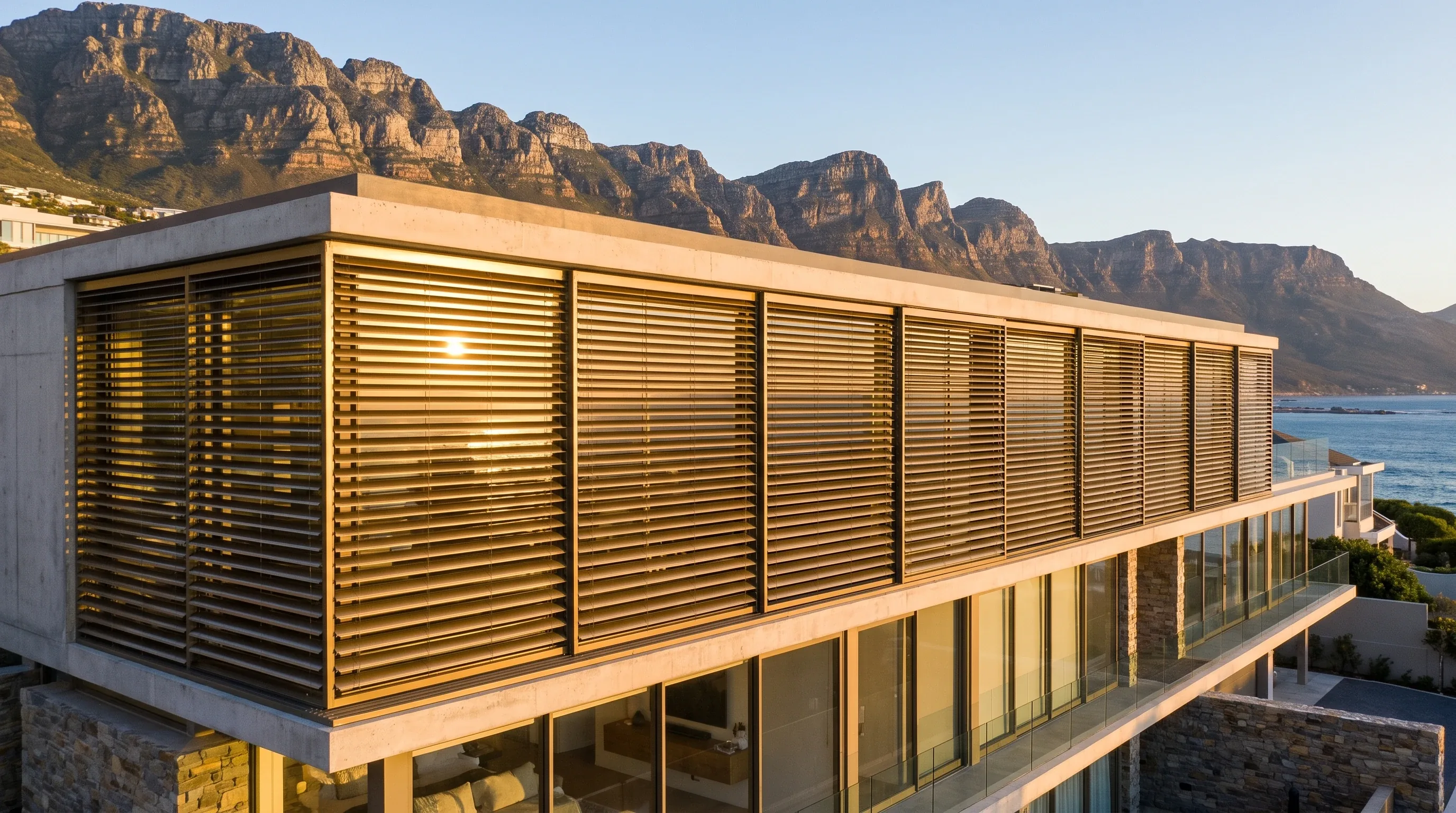
The practical rule: the further a wall turns from north toward west, the further outside the glass the answer has to move. An internal blockout absorbs solar heat only after the pane has already gained it, then radiates it back into the room. External shading — external venetian blinds, external roller shutters, a zip screen across the opening — intercepts it before the glass warms at all, which is why they are the premium tier of what we fit on this coast rather than a luxury add-on.
Shading, not security. Our roller shutters are made for sun, heat, glare and light control on the outside of the glass. They are not security-rated shutters — that is a different product, quoted separately on request.
4
Who owns the outside of your wall?
This one has nothing to do with the sun and it stops more jobs than any other. Broadly, the northern half of the strip — Mouille Point through Sea Point and into Bantry Bay — is dominated by sectional-title apartment blocks, while the southern half runs increasingly to freehold houses. Plenty of exceptions exist in both directions, which is exactly why it is a question rather than an assumption.
It matters because the glass line is the boundary. A blind fitted inside your reveal is a furnishing decision and yours to make. A headbox, a set of guide channels, an awning cassette or a shutter fascia fixed to the face of the building is a change to something you very likely share, and on a sectional-title scheme that means the trustees or the managing agent get a say — commonly over colour, over what is visible from the street, and over how the fixing is made.
Our part is to make that conversation easy: slim profiles, quiet colours, and the product data an application needs. What we will not do is describe an approval as a formality, or submit it on your behalf.
5
What does the wind do at your corner — not in your suburb?
The south-easter Capetonians call the Cape Doctor blows mainly through summer, roughly October to March, and the mountains around the city funnel and accelerate it; gusts of up to around 160 km/h have been measured over Table Bay.4 Winter then hands the coast over to north-westerly cold fronts, which arrive through the season at an average rate of about one every six days.5
None of that tells you what happens at your own opening, and that is the point. Wind on this strip is a local phenomenon, not a suburban one. A walled courtyard three metres below street level and an exposed corner terrace on the same property behave nothing alike. So the question is not “is my suburb windy” — it is “does the fabric on my balcony move on an ordinary summer afternoon, and how often.”
The answer decides the product. On a genuinely sheltered patio, a folding-arm awning is the simpler, cheaper and more pleasant answer, and a wind sensor turns it from a fair-weather toy into something that protects itself. On an exposed opening, an awning arm is the wrong tool and a zip screen is the right one: mesh held under tension inside side channels cannot flap, so it stays usable in conditions that would fold an awning away.
Putting it together
What each answer actually buys
Five answers, and the specification more or less writes itself. This is the shortlist we would arrive at, not a price list — everything is made to measure, so the real number comes from the measure.
| If your answer is… | What it points to |
|---|---|
| Low down, overlooked from the street | Day & night banded blinds or a double roller — daylight and privacy on one bracket, tuned band by band rather than all-or-nothing. |
| High up, water below the sight line | Sunscreen mesh that reaches the full drop, or external shading if the ceiling is being lit from underneath. |
| Spray genuinely reaches the opening | Aluminium venetian slats rather than fabric; sealed cassettes and coated fixings on anything outside. |
| West or south-west glass, no overhang help | External venetians or roller shutters first; sunscreen behind the glass as the honest second-best. |
| Sectional title, exterior fixing needed | Slim profile, quiet colour, spec sheet supplied for the trustees — agreed before anything is ordered. |
| Sheltered patio / exposed terrace | Folding-arm awning with a wind sensor / zip screen in side channels. |
| Wide glass, no safe reach to the head | Motorisation — on this coast that is a practical decision about ladders, not a gadget. |
Before you order anything
Two things a plan never shows
What is behind the plaster. Solid masonry, brick and cavity, a rebuilt stud wall, or an aluminium curtain-wall mullion with nothing solid to fix into. The substrate decides the bracket, and on a facade it decides whether an external system is viable on that wall at all.
Where the power is. Whether a socket is within reach of the window head, whether a battery tube can be recharged without a ladder, and whether a wired motor can be run without opening a finished ceiling. It is the difference between motorisation being easy and motorisation being a building job.
Both take about a minute to establish in the room and cannot be guessed from anywhere else. That, plainly, is why the measure exists and why it is free.
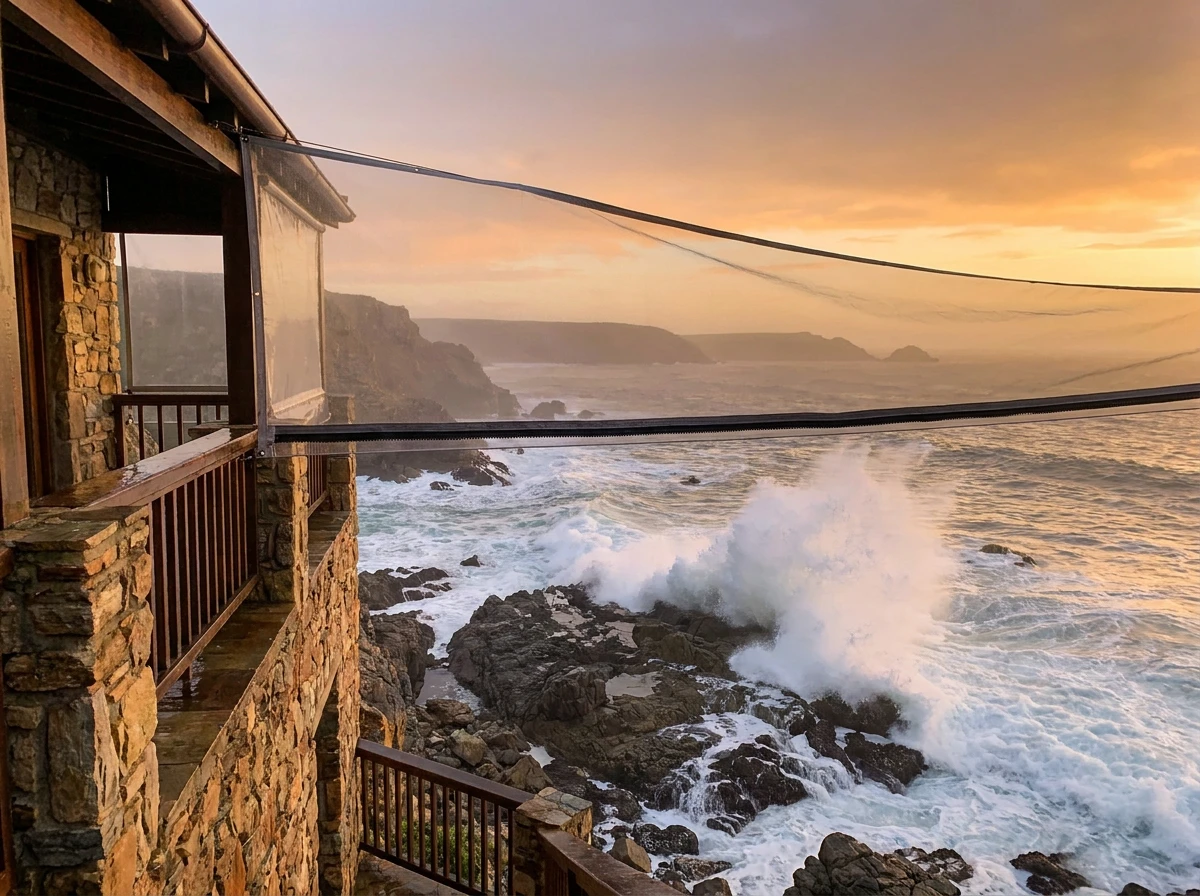
Mesh in side channels doesn't flap — which is the only reason an exposed terrace stays usable.
Answer them once, out loud, with a consultant in the room
Send this and one of our expert consultants will contact you shortly to arrange your free in-home measure — samples in hand, every opening measured, and a written quote itemised per window afterwards.
Nothing is priced off this page
The guide is free and stays free. It exists so the conversation starts somewhere useful, not so you owe us anything.
Bring the awkward window
The gable, the stairwell, the one nobody else would quote — those are the ones worth mentioning in the message box.
Sources
Every figure quoted above — latitude, solar altitudes and azimuths, the UV index, the rainfall split and the wind — comes from one of the following. Where a number reaches us through an aggregator rather than a primary weather-station dataset, we say so rather than dress it up.
- Gaisma — Cape Town sun and moon data (latitude −33.93°; December-solstice altitude at 12:00 about 75° and sunset azimuth 240°; June-solstice altitude at 12:00 about 31° due north, sunset azimuth about 297°). Solar-noon angles on this page are calculated (90 − the gap between latitude and declination, ±23.44°); the source's figures above are 12:00 readings.
- Nomadseason — Cape Town UV index (November average around 12, December around 14; the “extreme” band begins at 11). Aggregator source, not a primary measurement record.
- South Africa Gateway — South Africa's weather and climate (Cape Town's Mediterranean, winter-rainfall pattern; roughly 70% of annual rainfall between June and September).
- Cape Town Magazine — The Cape Doctor (the summer south-easter, roughly October to March; funnelling and acceleration around the mountains; gusts measured up to about 160 km/h over Table Bay).
- Cape Town Data — The Cape Doctor: why is Cape Town so windy? (winter cold fronts arriving on average about one every six days through the season).
The five questions, the mapping table and every product recommendation on this page are our own opinion, offered free and without obligation. Nothing here is a body-corporate or planning opinion — that belongs to your trustees, your managing agent and the City of Cape Town.
Still not sure which question is yours?
Ask in the chat — it costs nothing and it beats guessing from a photo.
Book your free measure